
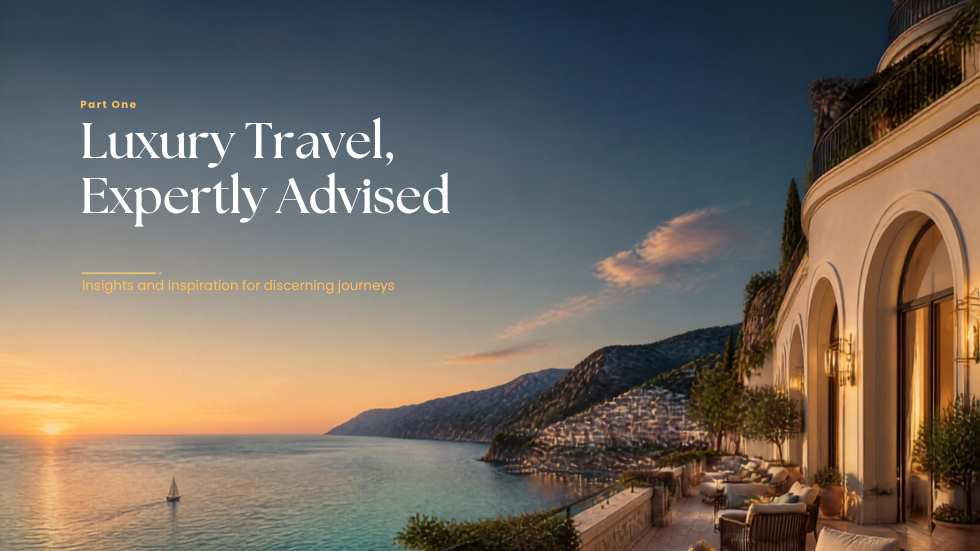
Luxury travel has evolved.
There was a time when the word luxury immediately brought to mind five-star hotels, first-class cabins, formal service, extravagant accommodations, and exclusive resorts. Those elements still have a place in the luxury travel market, but they no longer define it.
Today’s luxury traveler is increasingly looking beyond traditional symbols of status. The emphasis has shifted toward something more personal: time, space, access, authenticity, personalization, exceptional service, and the freedom to experience a destination on individual terms.
For travel advisors, understanding this evolution is important. Luxury is no longer simply a category of travel product. It is a way of designing and delivering an experience.
Luxury Has Become Personal
Perhaps the most significant change in luxury travel is that there is no longer one universally accepted definition of what makes a trip luxurious.
For some travelers, privacy is the ultimate luxury. Others value extraordinary service, access to experiences that aren’t readily available to the general public, or accommodations that provide a strong sense of place.
For another traveler, luxury may simply mean removing friction from the journey.
The common thread is personalization.
Today’s sophisticated traveler increasingly values an experience that feels intentionally designed rather than simply purchased.
This distinction is important because expensive does not automatically mean luxurious.
A high-priced hotel, tour, or experience may carry an impressive name or price tag, but if it doesn’t align with the traveler’s priorities, it provides little meaningful value.
True luxury begins with relevance.
Time Is Becoming One of Travel’s Most Valuable Commodities
Modern travelers often have something even more limited than money: time.
That has fundamentally changed how many people perceive luxury.
A seamless airport arrival, thoughtfully planned transportation, priority access, well-paced itineraries, strategically located accommodations, and knowledgeable local support can be every bit as valuable as an upgraded room category.
Luxury increasingly means eliminating unnecessary complications.
Travelers don’t necessarily want every minute of a vacation scheduled, but they do want the important details handled intelligently.
There is a significant difference between an itinerary that is full and one that flows.
The best luxury travel experiences protect the traveler’s time while still leaving room for discovery.
Access Is the New Exclusivity
Luxury has also shifted away from simply owning or purchasing something others cannot afford toward experiencing something others may not easily access.
That might mean visiting a location outside normal hours, meeting an artisan in a private setting, experiencing a destination with someone who has deep local knowledge, gaining access to a cultural experience in a more meaningful way, or simply discovering something most visitors never find.
These experiences don’t always need to be extravagant.
Often, their value comes from authenticity and connection.
As travelers become increasingly experienced and information becomes readily available online, simply seeing the major sights is no longer enough for many luxury clients.
They want context.
They want stories.
They want connection.
And increasingly, they want experiences that feel like they belong to the destination rather than experiences manufactured specifically for tourists.
Privacy, Space and Flexibility Matter More Than Ever
Another important shift in luxury travel is the growing value placed on privacy and personal space.
Private villas, residential-style accommodations, smaller hotels, private transportation, yachts, private guides, and customized touring continue to attract travelers who want greater control over how they spend their time.
But privacy shouldn’t necessarily be interpreted as isolation.
Often it simply means choice.
The ability to decide when to engage, when to explore, when to dine, and when to retreat has become an important part of the luxury experience.
Flexibility itself has become a form of luxury.
Service Should Feel Effortless
Exceptional service has always been associated with luxury travel, but today’s traveler often prefers service that feels intuitive rather than formal.
The most memorable service frequently happens quietly.
Preferences are remembered. Details are anticipated. Problems are resolved before they become disruptions. Assistance is available when needed without becoming intrusive.
Technology has made travel more convenient, but it has also made genuine human service stand out even more.
The ability to anticipate what a traveler may need—and respond quickly when circumstances change—remains one of the most important characteristics of luxury travel.
Authenticity Has Become Part of Luxury
Luxury travelers are increasingly interested in experiencing destinations rather than simply observing them.
Food, culture, history, art, architecture, traditions, local communities, and regional identity have become important components of sophisticated travel.
This has created an interesting evolution within the luxury market.
Some of the most memorable experiences may not be the most expensive ones.
A remarkable meal in an unexpected setting, an introduction to a local crafts person, a privately guided cultural experience, or time spent somewhere removed from the traditional visitor route may become the defining moment of an entire journey.
Luxury isn’t necessarily about adding more.
Sometimes it is about gaining deeper access to what is already there.
The Role of the Travel Advisor Is Evolving Along With Luxury
As the definition of luxury changes, so does the role of the professional travel advisor.
Information is everywhere. Travelers can research hotels, read reviews, compare prices, watch destination videos, and even use artificial intelligence to build an itinerary within seconds.
Information alone is no longer the differentiator.
Interpretation is.
The value of expertise lies in knowing which information matters, which experiences are worth the investment, which partners can be trusted, how the pieces of a journey should work together, and how to translate a traveler’s priorities into an experience that feels distinctly their own.
That requires destination knowledge, strong supplier relationships, continuing education, curiosity, and an understanding of how travelers themselves are changing.
The Future of Luxury Travel
Luxury travel is evolving beyond extravagance and exclusivity. Today’s luxury traveler values personalization, authenticity, flexibility, time, access, and exceptional service—experiences thoughtfully designed around what matters most to them.
For travel advisors, understanding these changing expectations creates new opportunities to build stronger client relationships and grow within this valuable market.
The luxury conversation continues! Watch for Part Two of our Luxury Travel Series coming soon, and don’t miss Power Solutions Atlanta, featuring a special panel discussion, “Selling Luxury.” TRUE advisors will gain valuable insights and ideas for understanding today’s luxury traveler and growing their luxury travel business.
Stay tuned, and we’ll see you in Atlanta!